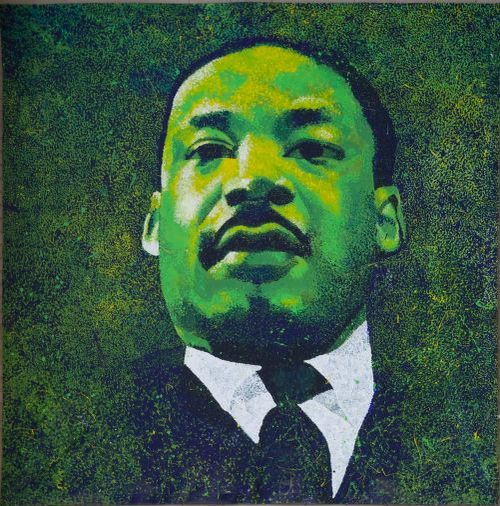
Republican lawmakers, aghast at discovering disturbing quotes from Martin Luther King Jr. smacking of critical race theory, are taking steps toward legislation cancelling the holiday. Freshman congresswoman Marjorie Taylor Greene, who insists she was King’s “biggest fan” until she read other statements he had made besides the ones frequently quoted from his big hit speech “I Have a Dream.”
“Did you know Martin Luther King Jr. said other things after he said the content of your character is what matters?” she queried reporters on Thursday. “Well, he did, and some of them were disgusting, critical race theory, I-hate-America things that the snugly, Disney caricature of Martin Luther King Jr. we white conservatives have clutched to our collective bosom would never, ever have said.”
Waving a sheet of King quotes she claimed proved King was a Marxist, critical race theorist who dreamed of oppressing innocent white school children, Greene proceeded to read some of the offending statements. “In his 1967 book, Where Do We Go From Here: Community or Chaos? King said this:”
Whites, it must frankly be said, are not putting in a similar mass effort to reeducate themselves out of their racial ignorance. It is an aspect of their sense of superiority that the white people of America believe they have so little to learn. The reality of substantial investment to assist Negroes into the twentieth century, adjusting to Negro neighbors and genuine school integration, is still a nightmare for all too many white Americans…These are the deepest causes for contemporary abrasions between the races. Loose and easy language about equality, resonant resolutions about brotherhood fall pleasantly on the ear, but for the Negro there is a credibility gap he cannot overlook. He remembers that with each modest advance the white population promptly raises the argument that the Negro has come far enough. Each step forward accents an ever-present tendency to backlash.
After a dramatic pause for effect, Taylor Greene told reporters, “Now if that doesn’t prove that Martin Luther King Jr. had a sinister plan to force white people to learn about systematic racism, then I don’t know what does. We cannot have a holiday celebrating a racist who insists that white people make an effort to comprehend their part in the complex racial history of our country.”
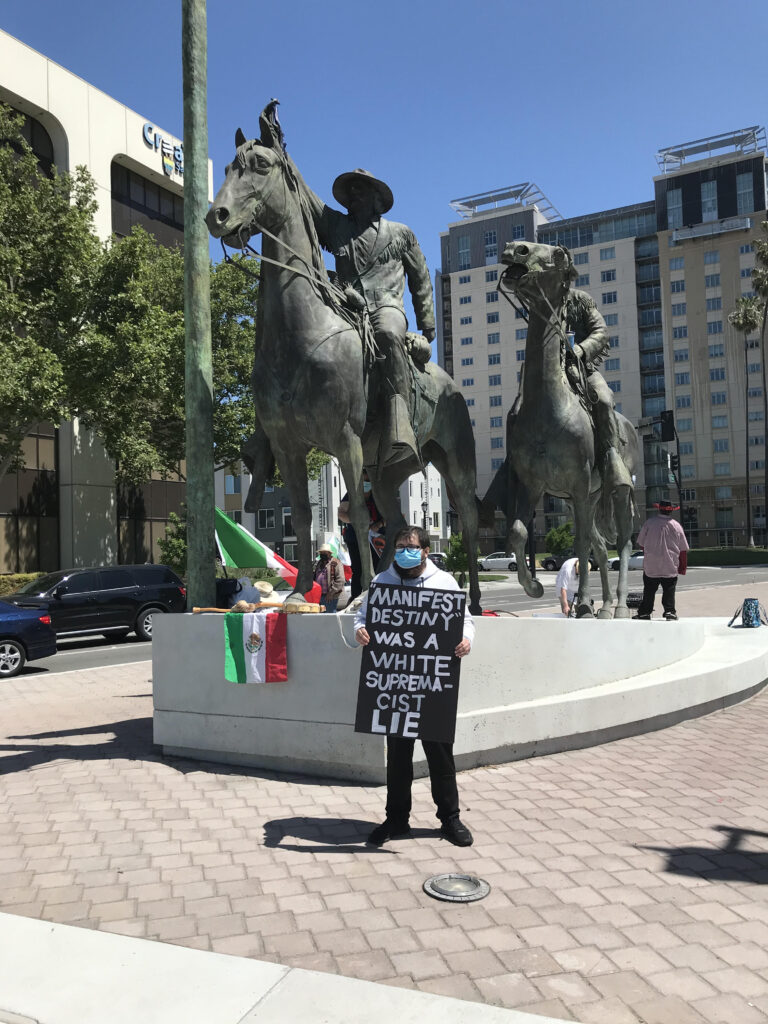
Manifestantes contra la estatua de Fallon el cinco de mayo.
Tengo varias conexiones personales con el controvertido monumento del “Capitán” Thomas Fallon que se encuentran los conductores que salen de la autopista 87 hacia el centro de San José. La estatua ecuestre triunfal está ubicada directamente en frente del edificio en el que yo vivo. Está del otro lado de la calle de la oficina en que mi madre trabajó por casi cincuenta años y probablemente el lugar donde conoció a Thomas McEnery, quien como alcalde ordenó erigir la estatua. De mi madre heredé una copia del diario ficticio de Thomas Fallon, California Cavalier: The Journal of Thomas Fallon, firmado por su autor, Thomas McEnery. Además, vivo a dos cuadras de la casa de Thomas Fallon que se enfrenta de manera incongruente al moderno mercado de San Pedro Square.
Cuando estaba completando mi trabajo de posgrado en la Universidad Estatal de San José, escribí un artículo de investigación sobre la ‘Bear Flag Rebelión’ (Rebelión de La Bandera del Oso) que Fallon y sus hombres llevaron a cabo en San José en Julio de 1846. Durante mi investigación, me sorprendió descubrir mi propia ignorancia sobre el lamentable golpe de estado que arrebató California de las manos de México y lo convirtió en parte de los Estados Unidos.
Dado que el estudio de la historia de los Estados Unidos generalmente comienza con los primeros asentamientos ingleses coloniales en Virginia y Massachusetts y se mueve hacia el oeste, la historia de California a menudo se trata como un evento tardío. Pero lo que realmente me asombró fue que yo había crecido en California y nunca aprendí los hechos básicos sobre la conquista estadounidense de California Mexicana. ¿Por qué fue eso?
La Rebelión de la Bandera Oso comenzó oficialmente el catorce de junio de 1846, pero otros eventos cruciales habían preparado el escenario. Los Estados Unidos habían anexado Texas en diciembre de 1845 después de que inmigrantes gringos arrebataron violentamente la provincia a México. En marzo de 1846 el “explorador” Capitán estadounidense John C. Fremont, a quien las autoridades mexicanas de Alta California le habían dado permiso para pasar por el valle del Río San Joaquín, violó de inmediato los términos de su visita al atravesar con su banda de sesenta hombres armados hasta San José, Santa Cruz y el valle de Salinas.
Cuando Fremont recibió una advertencia del general Mexicano José Castro para que abandonara la provincia el cinco de marzo, desafiante tomó una posición fortificada en el pico de Gavilán al noreste de Monterey e izó la bandera estadounidense. Cuando Castro y su ejército de doscientos cincuenta soldados se alistaban para desalojar a los estadounidenses, Fremont huyó con sus hombres el nueve de marzo.
Después de una breve estancia en Oregon, Fremont regresó al área de Sacramento en mayo de 1846. Mientras estaba en Oregon, Fremont había recibido cartas del Secretario de Estado James Buchanan y otros funcionarios del gobierno federal de los Estados Unidos. En sus memorias Fremont afirmó que dichas cartas “me dieron a conocer ahora bajo la autoridad del Secretario de la Marina que obtener California era el objetivo principal del presidente.”
El seis de junio, Fremont envió jinetes por el Valle de Sacramento repartiendo avisos sin firmar que afirmaban que un ejército de Californios marchaba sobre el valle, quemando casas, ahuyentando ganado y destruyendo cultivos. Los colonos anglosajones, que ya estaban agitados por rumores salvajes de depredaciones mexicanas y muchos de los cuales se creían con derecho a la tierra en virtud de su superioridad cultural y racial, se movilizaron y tomaron la antigua guarnición militar de Sonoma que estaba indefensa el 14 de junio.
Aquí es donde nuestro héroe local entra en escena. Para entonces Fallon, un inmigrante irlandés que había llegado al oeste con la expedición de Fremont de 1843 y permaneció en Alta California, se había convertido en un hombre de negocios y vivía en Santa Cruz. Desde su llegada Fallon había buscado oportunidades sin que las autoridades locales lo molestaran y estaba participando con entusiasmo en nuevas empresas.
Tras recibir noticias de la revuelta, Fallon a la cabeza de 19 hombres armados se movió a San José y el 14 de julio izó la bandera estadounidense sobre el palacio de justicia. Las fuerzas mexicanas bajo el comando de Castro habían salido de San José después de recibir la noticia de que el comodoro estadounidense Sloat se había apoderado de Monterey, que entonces era la capital de Alta California, el 7 de julio. Así que aquí tenemos a un hombre izando la bandera de un país del que ni siquiera era ciudadano sobre una ciudad de otro país en él que había sido recibido como inmigrante.
Thomas McEnery, el ex alcalde de San José que encargó la estatua en mención y autor del diario ficticio de Fallon, no tuvo nada que decir sobre la ética del comportamiento de Fallon. El diario está lleno de notas académicas a pie de página sobre las acciones de Fallon, muchas de las cuales proporcionan un contexto histórico esclarecedor. McEnery tiene una maestría en historia y estudió a Fallon de cerca, llegando incluso a visitar su ciudad natal en Cork, Irlanda. Pero la participación de su héroe en la toma armada de un país extranjero no se examina por completo en el trabajo de McEnery. Fallon es retratado como un aventurero bravucón en lugar de un líder paramilitar que ayuda a facilitar la conquista extranjera de un país que le dio la bienvenida como inmigrante.
Esto nos lleva directamente a mi pregunta de por qué nunca aprendí los hechos de la conquista estadounidense de la California Mexicana. La representación aduladora de Fallon por McEnery no es nada nuevo. Los primeros historiadores en las décadas después de la anexión de California establecieron la plantilla.
En pocas palabras la narrativa va así. Había unos salvajes viviendo en California, corriendo desnudos y recogiendo bayas salvajes. Luego los españoles llegaron y construyeron las misiones, que en ocasiones explotaban los indios. Los mexicanos se rebelaron y secularizaron las misiones y los Californios disfrutaron de un breve periodo de paraíso pastoral en sus haciendas y ranchos. Pero los Californios pasaban la mayor parte del tiempo vistiendo ropa elegante, disfrutando del fandango, las corridas de toros y otras fiestas, y realmente no estaban usando la tierra al máximo de su potencial. Luego los inmigrantes estadounidenses audaces y emprendedores se rebelaron contra los tiranos mexicanos, casualmente cuando estados unidos iba a la guerra contra México.
Si piensas que estoy exagerando, considera esta descripción de la sociedad Mexicana de California por Hubert Howe Bancroft, considerado el padre de la historia de California en su ensayo “California Mexicana de Lotos-Land”:
Ellos no eran una comunidad fuerte en ningún sentido, ni moral, ni física, ni políticamente; de ahí que, así como los salvajes se desvanecieron antes los superiores Mexicanos, así se desvanecieron los Mexicanos antes los estadounidenses. Grande fue su oportunidad, extremada al principio si se hubieran dedicado a construir una comunidad grande y próspera; y luego no menos maravillosa si hubieran poseído la habilidad de aprovechar el progreso y desempeño de otros. Muchos fueron despojados de sus tierras y posesiones; muchos desperdiciaron rápidamente el dinero obtenido por sus valores. Fueron tontos, imprevisivos, incapaces…
La noción de que los conquistados no estaban aprovechando al máximo sus oportunidades construyendo una civilización adecuada y, por lo tanto, debían dejar espacio para sus conquistadores fue la misma justificación utilizada por los colonos de las primeras colonias norteamericanas para diezmar a los nativos americanos y apoderarse de sus tierras. Para crédito de Bancroft, él reconoce que los “Californios fueron gravemente despojados por el pueblo de los Estados Unidos.” La escala del robo de las tierras y el fraude contra los Mexicanos en California después la toma de posesión de Estados Unidos fue tan grande que difícilmente se puede negar. Pero Bancroft argumenta que “los patriarcas ingenuos” de Alta California fueron un blanco fácil para los abogados tramposos que les robaron sus tierras. Entre los abogados charlatanes y los ocupantes ilegales, los californios perdieron sus tierras a un ritmo alarmante. Según el profesor de Notre Dame Felipe Fernandez-Armesto, autor de Our America: A Hispanic History of the United States, “en 1850, el 61 % de los Californios poseía tierras por valor de más de $100 (en dinero de 1850). Para 1860, la cifra había caído al 29 % y seguía cayendo.”
Los ocupantes ilegales fueron las tropas de choque del robo de tierras. Ocuparon las tierras de los propietarios, a veces hacían ofertas humillantes para comprarlas, luego utilizaron intimidación y violencia para obligar a los propietarios a marcharse si se negaban a vender al precio exigido. La familia Berryessa de San José, una de las familias propietarios más grandes de California, ofrece una clara ilustración del destino de muchos californios a manos de sus nuevos conquistadores.
Antes de que comenzara el acaparamiento de tierras, la familia Berryessa ya había sido víctima de la atrocidad anglosajona. Don José Reyes Berryessa, de 61 años, y dos de sus sobrinos adolescentes fueron asesinados a tiros por rebeldes de La Bandera de Osos, incluido Kit Carson, quien luego insistió que los asesinatos fueron ordenados por John C. Fremont. El trío desarmado había llegado a San Rafael en canoa mientras el mayor Berryessa buscaba visitar a sus hijos que habían sido hechos prisioneros por los estadounidenses en Sonoma, cuando los asesinaron. Después de la conquista, Nemasio Berryessa y dos de sus hermanos fueron linchados por anglos que luchaban por tomar el control de la mina de mercurio de su familia en San José. Según la historiadora Linda Heidenreich, “En 1880, un remanente de la familia Berryessa continuaba aferrándose a una pequeña propiedad en el extremo norte de Napa. A finales de siglo, no tenían tierras.”
En 2005 la hija de Thomas McEnery exhibió su documental “The Search for the Captain” en Cinequest, el festival del cine de San José. En dicho film Eric McEnery presenta los esfuerzos de su padre para erigir la estatua de Fallon y la controversia resultante. La película aparentemente incluye varios funcionarios de la ciudad que defienden la campaña de McEnery para financiar y ubicar la estatua y ataca a sus detractores como fanáticos “políticamente correctos.”
Y además el documental minimiza el hecho de que su padre inicialmente presentó el diario de Thomas Fallon, California Cavalier como si fuera un diario auténtico que fue descubierto detrás de una pared en la mansión vieja de Thomas Fallon durante una renovación. En la introducción original, McEnery comienza describiendo cómo el diario fue milagrosamente descubierto y describe en detalle el cambio de sus emociones cuando su escepticismo sobre la autenticidad del documento se convirtió en dicha causado por el “inmenso valor del documento que estaba sosteniendo en mis manos polvorientas.”
La admisión de que el diario era una obra de pura ficción no fue voluntaria por parte de McEnery. Solo salió a la luz cuando Javier Salazar, uno de los líderes de la protesta contra la estatua de Fallon, insistió en que McEnery produjera el documento real para que el público lo viera en 1978, el mismo año en que McEnery estaba ocupado encargando la estatua a un costo de $820,000 sin ninguna participación popular en el proceso. Como resultado de la exigencia de Salazar el libro de McEnery se volvió a publicar con una corrección y la Biblioteca Pública de San José lo trasladó de la sección de no ficción a la sección de ficción.
Los archivos de Cinequest todavía tienen la descripción de la película de Erin McEnery, la cual presume de una ignorancia impresionante que sólo el privilegio blanco y el patriotismo sin sentido pueden generar. “La estatua conmemoró el izamiento de la bandera estadounidense y la inclusión de California (sic) en los Estados Unidos durante la Guerra México-Estadounidense.” Si tan solo alguien les hubiera explicado a los californios que fueron despojados de su tierra o asesinados que estaban siendo “incluidos” en los Estados Unidos, seguramente habrían acogido con satisfacción su destino. Erin McEnery señala con precisión que “no se disparó ni un solo tiro” cuando Fallon izó la bandera, por lo que felicitaciones al Capitán por no disparar a ninguno de los civiles que quedaron a su suerte después de que Castro y sus tropas habían salido del pueblo.
La ignorancia de la cineasta me recuerda a la mía cuando escribí mi trabajo de investigación en el posgrado. Esa ignorancia es producto de una historiografía arraigada en la supremacía blanca, y la perspectiva de McEnery en 2005 ilustra que no hemos avanzado tanto desde que los Hubert Howe Bancrofts del mundo forjaron los cimientos de la historia.
La historia de la rebelión de la bandera del oso estuvo envuelta en mitos turbios precisamente porque un examen claro de los detalles revela una toma violenta y forzada del poder y la tierra basada en falsas pretensiones. Los argumentos de que el gobierno mexicano era inestable y oprimía a los indígenas locales ciertamente tienen mérito, pero ¿justifican su derrocamiento? Si un grupo de inmigrantes mexicanos decidiera de repente que California es hoy un estado mal administrado, como sostienen muchos conservadores modernos, ¿estaría justificado organizar una rebelión armada? ¿Celebrarían los gringos una estatua del líder mexicano de semejante revuelta años después y acusarían a los que protestaban de ser radicales políticamente correctos?
Afortunadamente, el Comité de Artes de San José votó este mes para mover la estatua y guardarla. Décadas de activismo por parte de manifestantes hispanos nos han traído a este momento. Si bien algunos han argumentado que Fallon no era el criminal atroz que sus críticos más estridentes sugieren, la rebelión y conquista militar en la que participó fueron un despojo que resultó en la muerte y pérdida de tierras y riquezas de muchos californios. La estatua es claramente una celebración triunfal y directa de ese evento. Lo veo todos los días y estoy harto de eso. Es hora de que se vaya, Capitán.
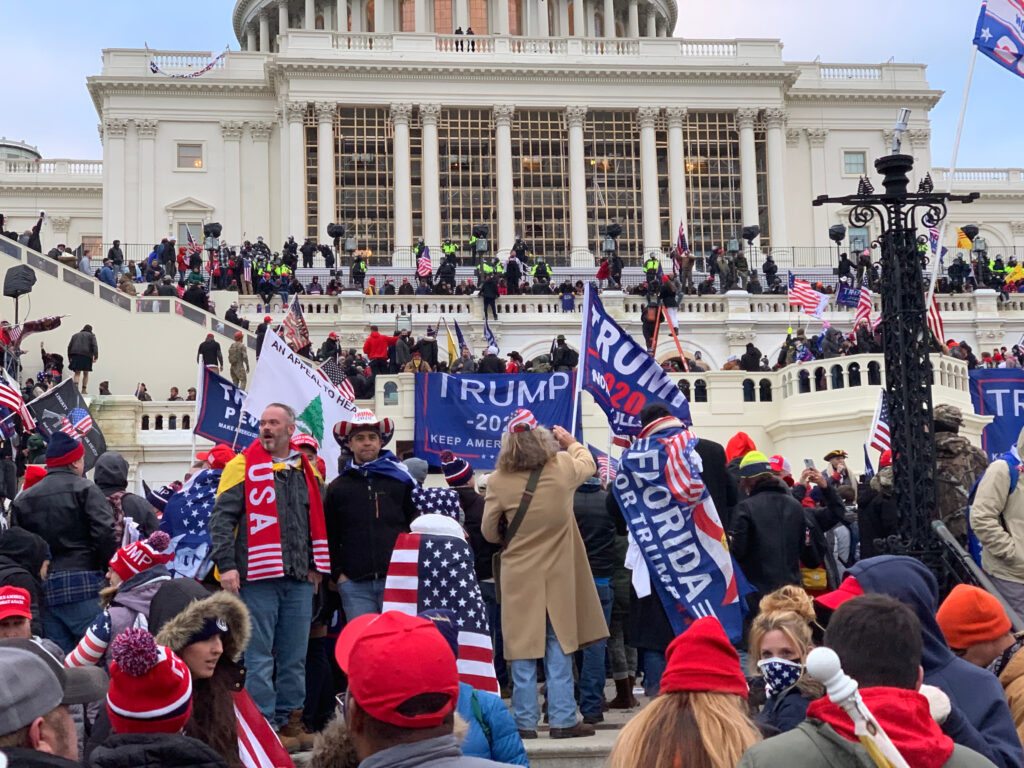
Critical Race Theory, disguised as Trump supporters, assaults the Capitol.
Republicans have yet another theory about who really attacked the U.S. Capitol on January 6th. According to Tucker Carlson and Texas Congressman Louie Gohmert, critical race theory, the graduate school framework for U.S. History, which claims systematic racism is embedded in all the major institutions of American life, disguised itself as hardcore Trump supporters that day and charged the citadel of American democracy.
“I happen to know for a fact that critical race theory teamed up with Antifa and the FBI in a conspiracy to make Trump supporters look bad,” Gohmert told reporters Friday. “And my sources tell me there were definitely de-gendered Mr. Potato Head provocateurs in the crowd that day as well.”
Asked about the hundreds of known Trump supporters who were arrested, many of whom insisted they acted at Trump’s orders and had long histories of attendance at Trump rallies, pro-Trump political activity and social media posts, Gohmert dismissed it all as “fake news.”
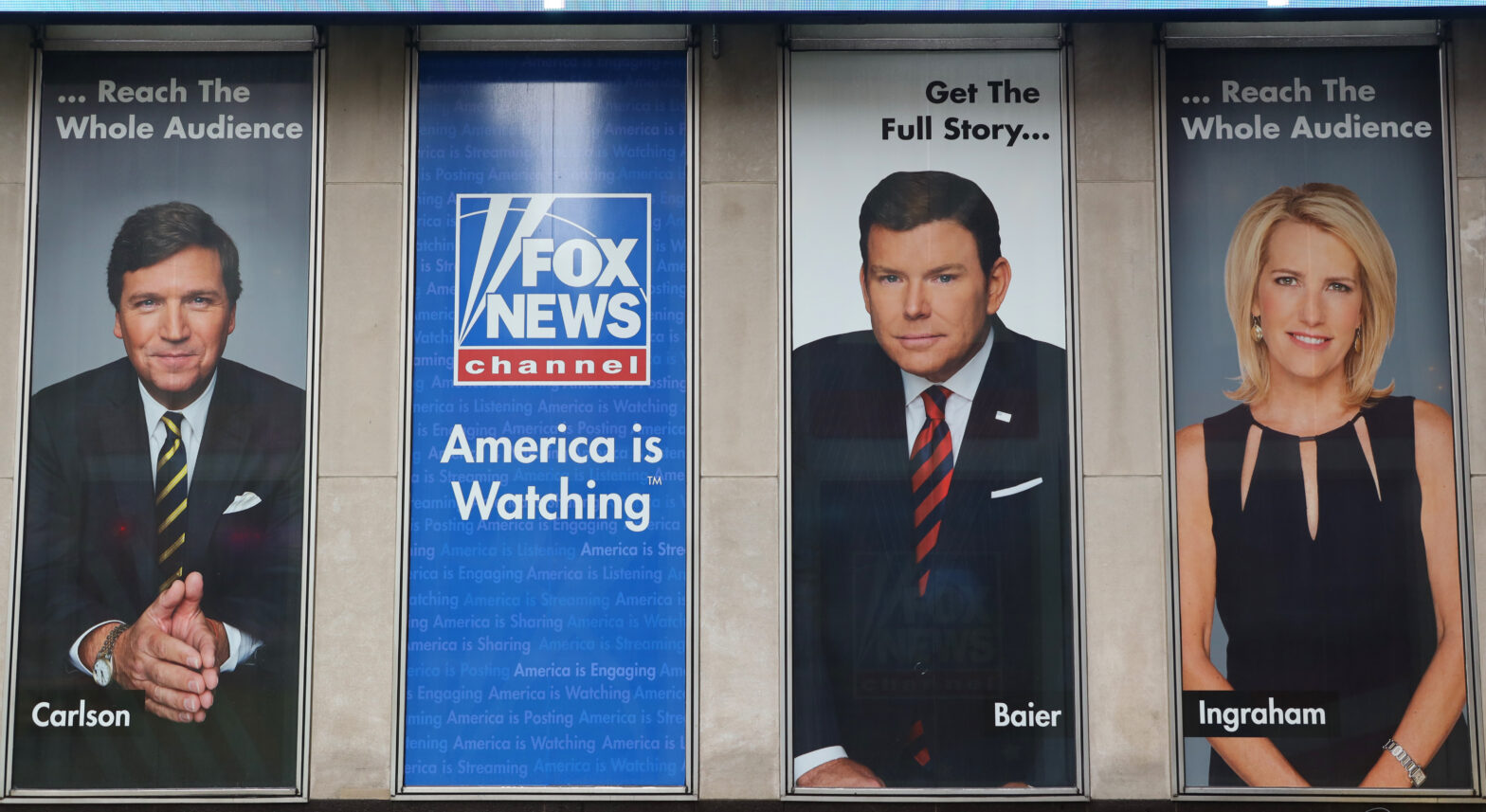
Fox News commentator Tucker Carlson devoted a segment of his Friday show to the new theory. “They won’t let us ask simple, basic questions about critical race theory’s involvement in the January 6th attack. Why not? What don’t they want us to discover? Why is the elite media covering up for critical race theory and January 6th? Is it because we might find out it plotted with the FBI, Antifa and Gay Pride Day to frame Trump supporters? Why aren’t honest, hard-working, white Americans like you allowed to ask questions which you would never be asking unless I asked you to ask them? Will you ask them? Remember, THEY won’t allow you to ask them.”
The party of free speech and local control is systematically using state governments to suppress any teaching in schools and universities that systematic racism has existed and continues to exist in the United States. Conservative legislatures in more than a dozen states have proposed or enacted laws to curtail the teaching about the role of racism in American society to ensure that white students never experience a moment of discomfort contemplating their favored status in housing, education, employment, medical care, and the legal system.
Conservatives have glommed onto the concept of “critical race theory,” a term that is certain to make your Fox News-watching uncle soil his trousers. CTR is a graduate school interpretation of American History that maintains that racism is embedded in virtually all the crucial institutions of American life and cannot simply be glossed over with a token paragraph here or there. Some of its tenets have filtered into high school and grade school curriculum.
The field of American History, which only developed into a professional discipline around the 1870s, was established largely by white men, some of whom openly espoused white supremacy in the early years, and apart from a few brave outliers like W. E. B. Du Bois, has been subject to critiques from scholars of color and other critics since only about the 1960s.
In the wake of the racial reckoning following the George Floyd murder, Republicans are desperate to preserve the Happy Days American History of the 1950s, in which white people cheerfully rose to the top through the Protestant work ethic and minorities appear only as bit players dusting the furniture in the background.
As former Vice President Mike “Go-Ahead-and-Hang-Me-If-It’ll-Make-America-Great-Again” Pence said during a speech on Thursday, “it’s past time for America to discard the left-wing myth of systemic racism.” So just to be clear, the Republican position is that voluminously documented practices such as employment discrimination, redlining, restrictive housing covenants, higher interest rates on mortgages, underfunded schools, the routing of highways through black and brown communities, poll taxes, black codes, and the disproportionate number of black people killed by police are all a “left-wing myth” concocted by Marxist miscreants who love to hate America.
For decades right-wingers have been fulminating about “revisionist” historians but rarely do they address the history that such academics are seeking to revise. Up until the mid 1950s the preeminent historian of American slavery was a man named Ulrich Bonnell Phillips, a descendant of plantation owners whose portrait of the peculiar institution in the antebellum South was essentially one big happy family where “in general the relations on both sides were felt to be based on pleasurable responsibility.”
While luxuriating in the “pleasurable responsibility” of a life sentence of unpaid toil, sexual exploitation and whippings, the slaves also enjoyed the educational benefits of plantation life according to Phillips. “On the whole the plantations were the best schools yet invented for the mass training of the sort of inert and backward people which the bulk of the American negroes represented.”
Perhaps Republicans would be happier if such traditional history was never revised. Some of the provisions of the laws they are proposing certainly make it seem so. A bill proposed in the Wisconsin state legislature, for instance, would strip any school deemed to have violated the prohibition on the teaching of institutional racism of ten percent of its annual state funding.
So let’s say an African-American teacher who studies the long history of racism in the country and whose family has personally suffered the impact of it over generations decides to share this knowledge with her classroom. The Republican Party of Wisconsin is trying to empower itself to punish that school for allowing that teacher to educate her students about a reality with which many of them may be unfamiliar. Will they grant themselves the power to fire such a teacher in their next round of bills? Perhaps after that they could pass laws prohibiting the hiring of instructors who appeared likely to teach such concepts. It would not be the first time such laws were on the books.
Mike Jaworski was sure he was a staunch supporter of former President Trump. He voted for Trump twice, attended several rallies where he screamed “build the wall” and “lock her up,” and had a thirty foot long Trump flag in front of his home. He flouted COVID 19 restrictions, contracted the disease, gave it to his father who subsequently died and then blamed the Chinese government for his father’s death after initially dismissing the pandemic as a hoax. He participated in the January 6th insurrection at the Capitol and was arrested after being caught on tape stomping on the head a Capitol Police Officer.
But since his arrest in January of this year, Jaworski has come to a startling realization. “I was Antifa all along,” a shaken Jaworski confessed from his cell in Washington, DC during a Zoom interview. “I just didn’t know it.” Asked how he could possibly be a member of Antifa given the voluminous evidence of his allegiance to former President Trump, Jaworski gave a lengthy response.
“How do I know I’m Antifa? By the unassailable, undeniable fact that a true supporter of my President Donald Trump, who I love with all my heart and I know was chosen by God to lead this great country, would never ever do the terrible things I am clearly seen doing on January 6th on that video. A man who would stomp on the head of a police officer who was protecting the U.S. Capitol while covered from head to toe in Trump gear could only have been Antifa. I just don’t remember joining or attending meetings or swearing a blood oath to Saul Alinsky, but clearly there is no other possible explanation for my behavior. They are so devious that they enlist you without your even knowing it. The next thing you know you’re masquerading as a patriotic Trump supporter and stomping on a cop’s head.”
Protesters at the Fallon statue on Cinco de Mayo, 2021
I have several personal connections to the controversial “Captain” Thomas Fallon monument that confronts motorists exiting Highway 87 into downtown San Jose. The triumphal equestrian statue is situated directly in front of the building I live in. It’s also right across the street from the building my mother worked in for nearly fifty years, and probably the place where she met Tom McEnery, the man largely responsible for erecting the statue. I inherited a copy of Captain Fallon’s fictionalized diary, California Cavalier: The Journal of Captain Thomas Fallon signed by the author, Tom McEnery. I live two blocks from Fallon’s old home, which incongruously faces the trendy San Pedro Square Market.
When I was completing my graduate work in American History at San Jose State, I also wrote a research paper about the Bear Flag Rebellion, which Fallon and his gang brought to San Jose in July of 1846. During my research, I was shocked to discover my own ignorance of the shabby coup d’etat that ultimately pried the Golden State from the hands of Mexico and made it part of the United States.
Since the study of United States History traditionally begins with the early English colonial settlements in Virginia and Massachusetts, and then gradually moves westward as the Republic expands across the continent, California history is usually treated as an afterthought. But what really blew my mind was the fact that I had grown up in California and never been taught any of the basic facts around the U.S. takeover of Mexican California. Why was that?
The Bear Flag Revolt officially started in Sonoma, California on June 14th, 1846, but other crucial events had set the stage. The United States had annexed Texas in December of 1845 after gringo immigrants had violently wrested the province from the Mexican government. In March of 1846, the “explorer” U.S. Captain John C. Fremont, who had been been given permission by the Mexican authorities of Alta California to pass through the valley of San Joaquin River, immediately violated the terms of his visit by leading his band of sixty armed men through San Jose, Santa Cruz and the Salinas Valley.
When Fremont received a warning from Mexican General Jose Castro to leave the province on March 5th, he defiantly took up a fortified position on Gavilan Peak northeast of Monterey and raised the American flag. After Castro assembled two-hundred and fifty troops to dislodge the Americans, Fremont fled with his men on March 9th.
After a brief sojourn in Oregon, Fremont returned to the Sacramento area in May of 1846. While in Oregon, Fremont had received letters from Secretary of State James Buchanan and other U.S. government officials that he later claimed in his memoirs made it “known to me now on the authority of the Secretary of the Navy that to obtain California was the chief objective of the President.”
On June 6th, Fremont sent horsemen throughout the Sacramento Valley carrying unsigned notices claiming that an army of Californios was marching on the valley, burning houses, driving off cattle and destroying crops. Anglo settlers, who were already agitated by wild rumors of Mexican depredations and many of whom believed themselves entitled to land by virtue of their cultural and racial superiority, mobilized and seized the undefended former military garrison town of Sonoma on June 14th.
Here is where our local hero enters the picture. By this time, Fallon, an Irish immigrant who had come west with the Fremont expedition of 1843 and remained in Alta California, had become a businessman and was living in Santa Cruz. Fallon had pursued opportunities unmolested since his arrival and was eagerly engaging in new enterprises when news of the revolt reached him.
Nonetheless Fallon rode into San Jose with nineteen armed men and on July 14th he raised the American flag over the courthouse. Mexican forces under Castro had fled San Jose after receiving the news that U.S. Commodore Sloat had seized Monterey, which was then the capital of Alta California, on July 7th. So here we have a man hoisting the flag of a country of which he was not even a citizen over the city of another country in which he had been welcomed as an immigrant.
Thomas McEnery, the former San Jose mayor, the man who had brought the Fallon statue to San Jose and author of Fallon’s fictionalized journal, has nothing to say about the ethics of Fallon’s behavior. The journal is full of scholarly footnotes on Fallon’s actions, much of it providing highly illuminating historical context. McEnery has a masters degree in history and studied Fallon closely, going so far as to visit his hometown in Cork, Ireland. But his hero’s participation in the armed seizure of a foreign country goes entirely unexamined. Fallon is portrayed as a swashbuckling adventurer rather than a paramilitary leader helping to facilitate the foreign conquest of a country that welcomed him as an immigrant.
This leads us directly to my question of why I had never learned the facts of the U.S. conquest of Mexican California while growing up in California. McEnery’ s fawning portrayal of Fallon is nothing new. The early historians of California in the decades after the annexation of California set the template.
In a nutshell the narrative is as follows. There were savages living in California, running around naked and picking wild berries. Then the Spanish came and built the beautiful missions, which sometimes exploited the Indians. The Mexicans revolted, secularized the missions, and the Californios enjoyed a brief period of pastoral paradise on their haciendas and ranchos. But they spent most of their time wearing fancy clothes, doing the fandango, bullfighting, and having fiestas, and they were not really using the land to its fullest potential. Then the bold, enterprising American immigrants rebelled against the Mexican tyrants, coincidentally, just as the United States was going to war against Mexico.
If you think I’m exaggerating, ponder this description of California’s Mexican society from Hubert Howe Bancroft, largely considered the father of California history, in his essay “Mexican California of Lotos-Land”:
They were not a strong community in any sense, either morally, physically, or politically; hence it was that as the savages faded before the superior Mexicans, so faded the Mexicans before the superior Americans. Great was their opportunity, exceedingly great at first if they had chosen to build up a large and prosperous commonwealth; and later no less marvelous, had they possessed the ability to make avail of the progress and performance of others. Many were defrauded of their stock and lands; many quickly squandered the money realized from a sudden increase in values. They were foolish, improvident, incapable…
The notion that the conquered were not making the most of their opportunities or building a proper civilization and thus must make room for their more industrious conquerors was the same justification used by settlers of the early North American colonies to decimate the Native Americans and seize their lands. To Bancroft’s credit, he does acknowledge that the Californios “were grossly sinned against by the people of the United States.” The scale of land theft and fraud perpetrated against Mexicans in California that followed the U.S. takeover was so great that it could scarcely be denied. But Bancroft argues that the “simple-minded patriarchs” of Alta California were easy marks for the shyster lawyers who robbed them of their lands.
Between the charlatan lawyers and aggressive squatters, Californios lost their lands at an alarming rate. According to Notre Dame Professor Felipe Fernandez-Armesto, author of Our America: A Hispanic History of the United States, “in 1850, 61 percent of them owned land worth more than $100 (in 1850’s money). By 1860 the figure had fallen to 29 percent, and it continued to fall.”
The squatters were the shock troops of the land theft. They squatted on owners’ lands, sometimes making humiliating offers to buy them, then used intimidation and violence to force the owners out if they refused to sell at the demanded price. The Berryessa family of San Jose, one of the largest landholding Californio families, provides a stark illustration of the fate of many local landowners at the hands of their new conquerors.
Before the land grab even commenced, the Berryessa family was the victim of an Anglo atrocity. Sixty-one year old Don Jose Reyes Berryessa and two of his teenage nephews were gunned down by Bear Flag rebels including Kit Carson, who later insisted the killings were ordered by John C. Fremont. The unarmed trio had arrived in San Rafael by canoe as the elder Berryessa sought to visit his sons who had had been taken prisoner by the Americans at Sonoma. After the conquest, Nemasio Berryessa and two of his brothers were lynched by Anglos struggling to seize control of the family’s mercury mine in San Jose. According to historian Linda Heidenreich, “In 1880 a remnant of the family continued to hold onto a small piece of property at the northern end of Napa. By the close of the century, they were landless.”
In 2005 Thomas McEnery’s daughter Erin showed “In Seach of the Captain,” her documentary about her father’s quest to mount the statue and the ensuing controversy at Cinequest, the San Jose film festival. The film apparently includes several city officials defending McEnery’s drive to fund and mount the statue and attacks his detractors as politically correct zealots.
It also downplays the fact that her father initially presented the Thomas Fallon journal California Cavalier as an authentic diary that had been discovered walled up in the old Fallon mansion during its renovation. In the original introduction, McEnery begins by describing how the journal was miraculously found and details his rising exuberance as he went from being skeptical of its authenticity to becoming enthralled by “the immense value of the document I held in my dusty hands.”
The admission that the journal was a work of pure fiction was not voluntary on McEnery’s part. It only came to light when Javier Salazar, one of the anti-statue protest leaders, insisted that McEnery produce the actual document for public viewing in 1978, the same year that McEnery was busy commissioning the statue at a cost of $820,000 without any public participation in the process. The book was republished with a disclaimer and the San Jose Public Library moved it from the non-fiction section to fiction.
Cinequest’s archives still has Erin McEnery’s film description, which boasts a breathtaking ignorance that only white privilege and mindless jingoism can spawn. “The statue commemorated the raising of the American flag and Californias (sic) inclusion into the United States during the Mexican-American War.” If only someone explained to the Californios who were stripped of their land or murdered that they were being “included” into the United States, they surely would have welcomed their fate. She does point out accurately that “not one shot was fired” when Fallon raised the flag, so kudos to the Captain for not shooting any of the civilians who were left to fend for themselves after Castro and his troops fled the town.
The filmmaker’s ignorance reminds me of my own when I wrote my research paper back when I was doing my graduate work. That ignorance is the product of a historiography entrenched in white supremacy, and McEnery’s perspective in 2005 illustrates that we have not advanced that far since the Hubert Howe Bancrofts of the world forged its foundation.
The history of the Bear Flag Revolt was shrouded in murky myths precisely because a clear examination of the details reveals a crude, forcible seizure of power and land based on paper thin pretenses. Arguments that the Mexican government was unstable and oppressed the local indigenous people certainly have merit, but would that justify its overthrow? If a group of Mexican immigrants today suddenly decided California was a badly mismanaged state, as many modern conservatives argue, would they be justified in staging an armed rebellion? Would gringos celebrate a statue of the Mexican leader of such a revolt years later, and accuse those who protested of being politically correct radicals?
Thankfully, the San Jose Arts Committee voted this month to remove the statue and put it into storage. Decades of activism by Hispanic protesters have brought us to this moment. While some have argued that Fallon was not the heinous criminal his most strident critics make him out to be, the rebellion and military conquest he participated in was a naked land grab that resulted in the deaths and loss of land and wealth of many Californios. The statue is clearly a triumphal, in-your-face celebration of that event. I see it every single day and I am sick of it. It is time for you go, Captain.
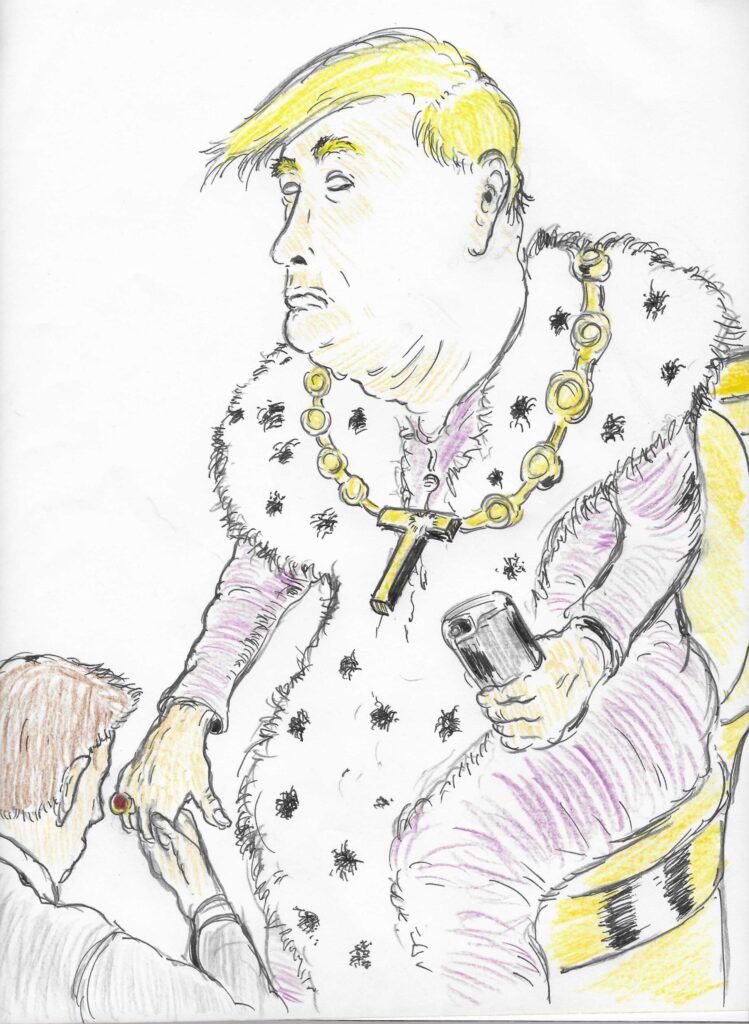
So you’re an ambitious Republican seeking advancement and you jettisoned any trace of dignity, integrity, self-respect, principles or independent critical thinking in time to catch the great MAGA wave that OUR GREAT LEADER rode into the White House in 2016. Or maybe you hung back, criticized HIS obvious lies, stood on principle and pledged to stand up for true conservative values before coming to your senses and joining the congregation.
Either way, your path forward still requires a public act of ritual self-abasement at Mar-a-Lago that would make a macabre vignette in a Hieronymus Bosch triptych but will endear you forever to the obstreperous January 6th patriots that now rule the party. There are highly specific rules to follow if you truly wish to submit in a manner sufficiently obsequious to curry HIS favor should you be lucky enough to be granted an audience with HIM at Mar-a-Lago.
Before You Come to Mar-a-Lago
Book a fundraising event at Mar-a-Lago. Nothing will get ol’ 45 in your corner as quickly as your deposited funds in the Trump organization’s coffers. But make sure to remind him of your booking at the appropriate moment. The President has a lot on his mind and he may forget your event and for that matter your name during a round of golf.
What to Do When You Come Into HIS Presence
When you enter the room, make sure not to look directly at President Trump. The President does not tolerate impertinence. Look at the floor. Remember, if he backs another candidate in your primary, you might have to go back to running that chain of laundromats or gyms or return to working for your father’s law firm. Do not speak to him until he addresses you, and make sure not to sit down until he tells you to do so. If you are having lunch together, make sure to take his advice on what to order and tell him how much you enjoyed it.
It is a good idea to bring up his incredible electoral college victory of 2016 at the earliest possible moment in the conversation as that is likely to ease him into a favorable state of mind. You might offer something like, “This is the best steak I ever had, Mr. President. It reminds me of your incredible electoral college landslide of 2016.” Be prepared to smile and nod your head as he launches into a forty-five minute long monologue on that topic. (Pro tip: You don’t have to actually listen. The President does not pay keen attention to the engagement of his audience. Just wait for him to stop talking.)
Once the President has exhausted that topic, segue to the stolen election of 2020. You can simply say something like, “After your great electoral college victory of 2016 and all your great achievements as President, they had to steal the 2020 election.” Prepare yourself for another monologue of indefinite duration. Make sure to stifle any involuntary laughter should the President reference bamboo ballots flown into Arizona from China, Hugo Chavez, Italian satellites or thousands of dead voters.
What NOT to Do After Your Visit
Do not immediately post photos of yourself grinning vacantly and giving the thumbs up at the table with President Trump like Ted Cruz and Marco Rubio did. You will look like those desperate middle aged men at the adult book store having their picture taken with the porn star who appears as though she were being held hostage in a burning latrine.
Wait a decent interval, at least a day. You don’t want to appear as the desperate, pathetic sycophant you actually are. Yes, you want the President’s luster to briefly illuminate your wretched existence, but a certain subtlety is required. Everyone despises a servile flunky clinging to a popular figure because of their own shocking absence of substance and character. Avoid the pale, obsessive fanboy look that Cruz and Rubio have flaunted and try to appear as a bold partner in President Trump’s mission to make America great again again. With a little luck, the President will endorse you, and you can embrace the challenge of parroting his incoherent conspiracy theories with a straight face for many years to come. With time that feeling of disgust you get when you look in the mirror will fade.
Washington D.C.–A bold, new Republican Congressional caucus headed by Margorie Taylor Greene made a big splash last week by announcing its intentions to uphold America’s “respect for uniquely Anglo-Saxon traditions” and suggesting that immigrants who arrived after 1965 were swarthy, disloyal slackers who put their feet up and collected welfare at the expense of industrious, flaxen-haired Heartland patriots.
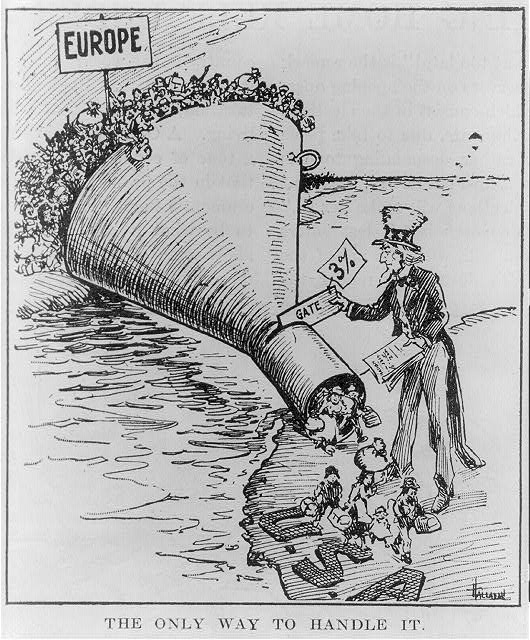
The America First Caucus, led by the Georgia firebrand who first identified the Jewish Space Laser as the source of California’s wild fires, produced a policy paper that caused quite a stir in Congress and the media when it was published by the Punchbowl News site. The paper daringly reintroduces the racial pseudo science of the early twentieth century, which led to the exclusion of Asian immigrants and severe restrictions on southern and eastern Europeans in the National Origins Act of 1924. That act was only repealed in 1965, and since then, decent white Americans have been denied the right to work long hours in the hot sun picking strawberries with few bathroom breaks and been forced to endure the torment of hearing conversations in foreign languages while at the grocery store.
The paper, which somehow neglects to use the Klan trope “old pioneer stock,” argues that “an important distinction between post-1965 immigrants and previous waves of settlers is that previous cohorts were more educated, earned higher wages and did not have an expansive welfare state to fall back on when they could not make it in America and thus did not stay in the country at the expense of the native born.”
This, of course, would be news to the undocumented immigrants and Dreamers, who are ineligible to receive food stamps, medicaid, Supplemental Security Income, Temporary Assistance for Needy Families or healthcare subsidies under the Affordable Care Act. It would also be news to millions from the “previous cohorts of settlers” that they were all well-educated, high wage earners who made the arduous, life-threatening journey across the ocean not due to any poverty, political instability or lack of opportunities at home but rather just for the chance to sing “America the Beautiful” with the chirpy pep squad of the Greatest Nation on Earth.
Fox Corporation fired popular white supremacist talk show host Tucker Carlson Tuesday for comments he made last week endorsing a white supremacist conspiracy theory. Fox CEO Lachlan Murdoch, who made the announcement Tuesday night, was clearly livid that Carlson had espoused the “great replacement” theory during an appearance on Fox News Primetime. The theory promulgates the notion that the Democratic party is “importing” swarthy, docile Third World immigrants into the United States in order to replace true American voters in a diabolical plot to transform the country into polyglot, socialist hellscape.
Roger Metzger, Editor for the daily Ubermensch Bliztkrieg immediately offered Carlson a job upon hearing of his firing. Carlson has yet to reply to Mr. Metzger’s proposal.
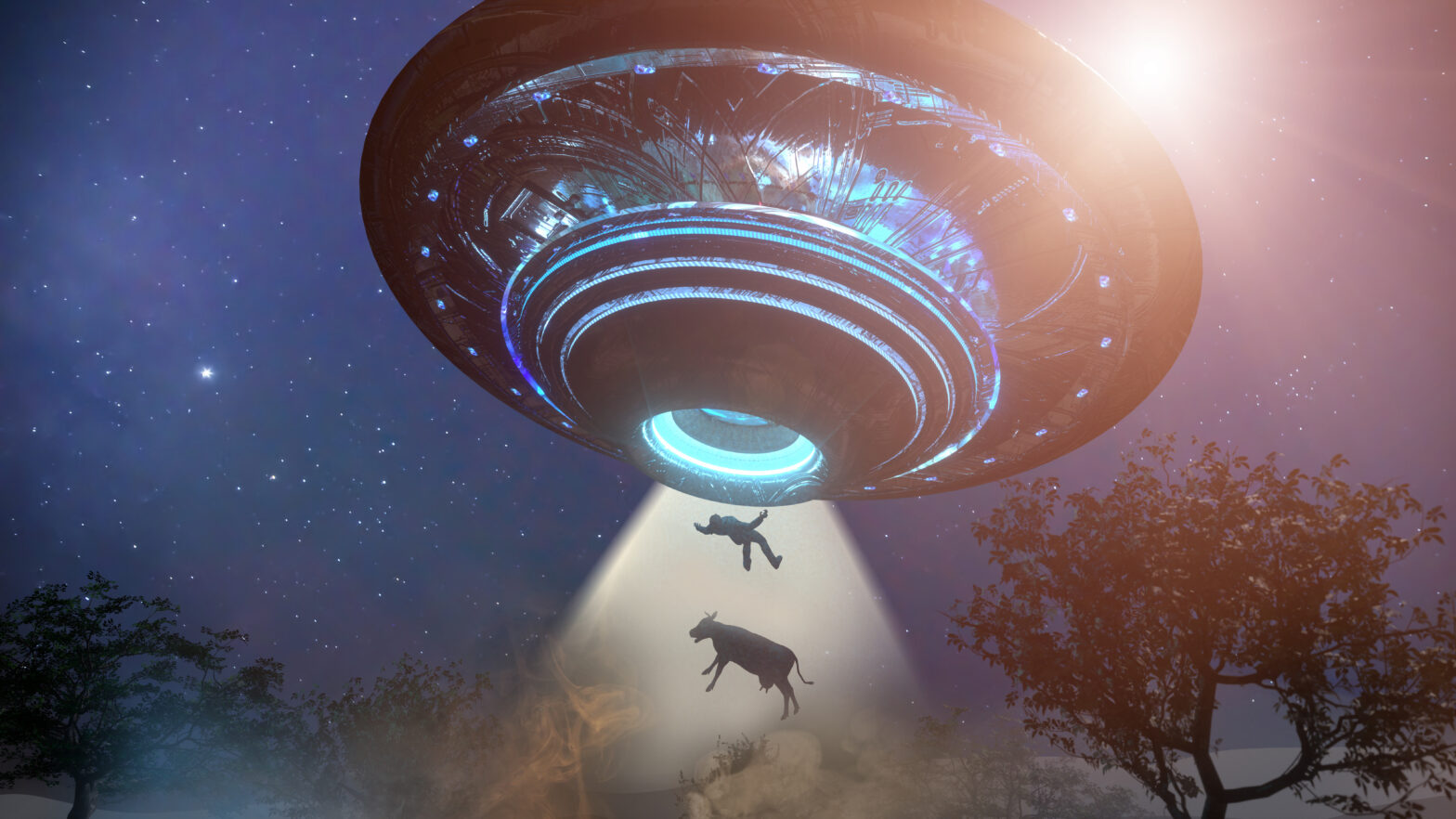
Atlanta, Georgia–Republicans in Georgia, fresh off their Election Integrity Law triumph, passed a law prohibiting alien abductions in the Peach State on Friday. The law, dubbed “The Alien Abduction Integrity Act,” which also outlaws the use of anal probes by extraterrestrial visitors on Georgia residents, sailed through both houses of the state legislature in a matter of hours, and Governor Brian Kemp declared he was eager to sign the bill next week.
While critics have claimed that alien abductions are an absurd myth concocted by mentally unstable people, Republicans insist that they are simply responding to the reasonable concerns of their constituents. “We have hundreds of sworn affidavits from our citizens who were taken aboard alien spacecrafts against their wills,” said Representative Slade Greenwall. “Many of them were subjected to scientific experiments while onboard those crafts, including being anally probed. It would be a gross dereliction of our duty not to pass legislation to protect them.”